




We Take Fraud Seriously
Every dollar you earn on Shark Earnings comes from real task completions, real surveys, and real advertiser budgets. When fraudulent accounts abuse our platform, real users pay the price, with fewer offers, tighter cashout limits, and less advertiser trust. That's why fraud prevention isn't an afterthought at Shark Earnings: it's a core part of how we run the platform, and it shapes every decision we make about which tools we invest in.
The two rules this enforces in practice are the one account per person policy and the VPN and proxy policy. This article is a full, honest look at why we chose Verisoul, what we use it for, how it fits into our broader security stack, and what that means for you as a legitimate user. We'll also share some of the numbers from our own platform so you can see just how real the problem is, and how meaningful the improvement has been.
Why We Switched to Verisoul
Shark Earnings launched with IPQS (IPQualityScore) and FingerprintJS as the backbone of our fraud detection. Both are respected tools with large customer bases. But as Shark Earnings scaled, specific cracks appeared:
- IPQS was solid at IP reputation checks but its device-level signals were inconsistent across mobile carriers and shared WiFi networks, we saw both over-flagging of innocent users (especially on college campuses and workplaces with shared IPs) and under-flagging of determined fraudsters using residential proxies that hadn't yet landed on IPQS blocklists.
- FingerprintJS excelled at browser fingerprinting but by design it only links devices, not identities. A fraudster running three accounts on three different phones was completely invisible to it. Account linking, one of the most critical signals for a reward platform, simply wasn't in scope.
- Anti-detect browsers like Multilogin, GoLogin, and AdsPower are explicitly designed to defeat browser fingerprinting. They rotated through convincing fingerprint profiles, and FingerprintJS's detection for spoofed environments was limited.
- Running two separate vendor APIs meant double the integration overhead, double the data to reconcile, double the dashboards to monitor. Neither tool knew what the other was seeing.
We evaluated several alternatives over a two-month period. Verisoul was the only one that solved all of these problems simultaneously, with a single integration, and with measurably higher accuracy on the test dataset we ran from our own user base.
We made the switch, and we haven't looked back.
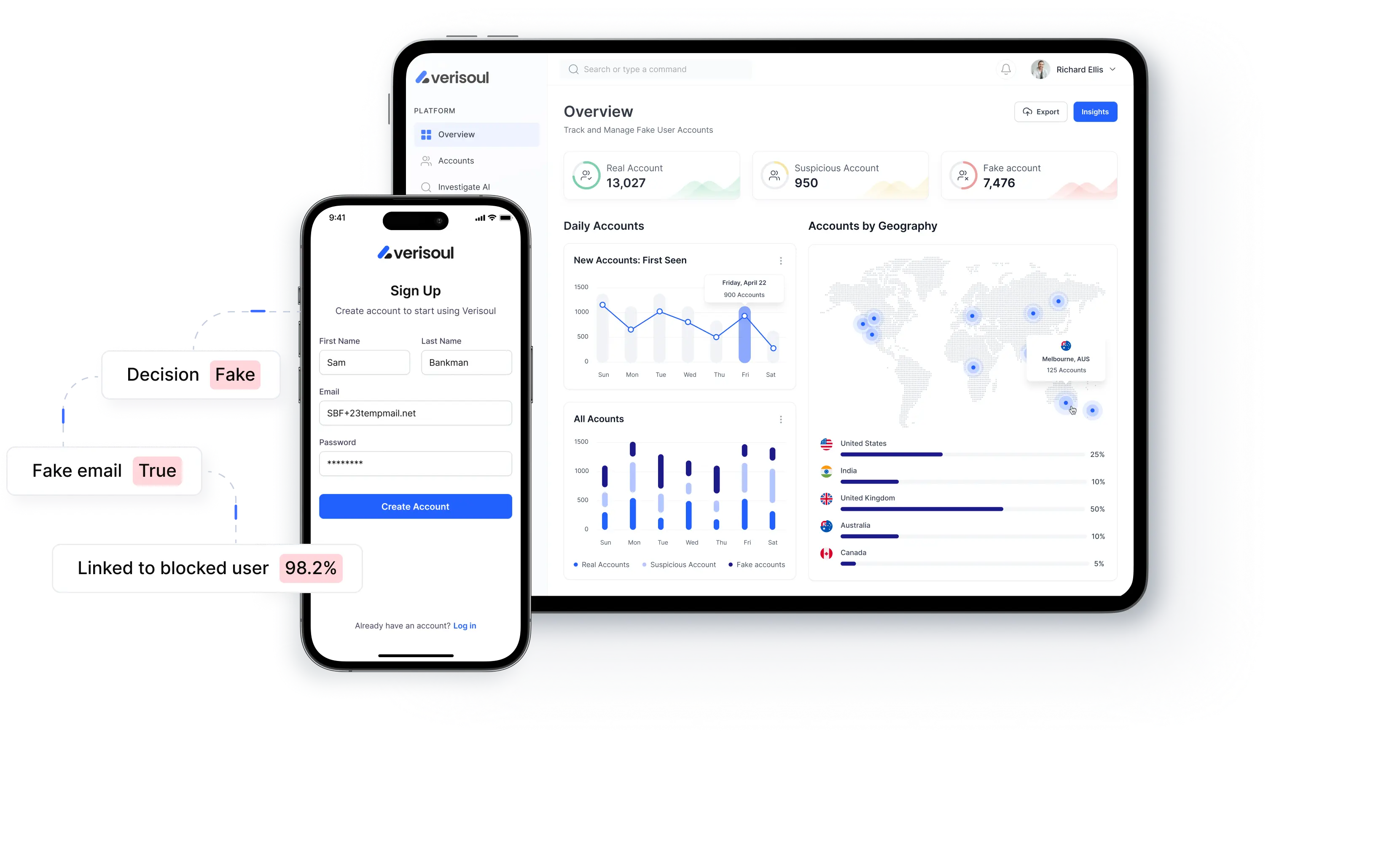
What Is Verisoul?
Verisoul is a San Francisco-based fraud prevention platform built specifically to stop fake accounts, bots, and multi-accounting at scale. Their core mission is deceptively simple: ensure every user on your platform is real, unique, and human.
What makes Verisoul different from point solutions is the depth of integration between signals. Device fingerprinting, probabilistic account linking, bot behavior analysis, email intelligence, proxy/VPN detection, and geolocation aren't siloed, they share context with each other. A device with a suspicious fingerprint that's also connecting from an anonymizing proxy and registered with a three-day-old email address doesn't get three separate low-confidence flags. It gets one high-confidence fraud verdict, because all three signals reinforce each other.
Verisoul is used by platforms across the fintech, gaming, gig economy, and rewards sectors. Their shared fraud intelligence network means that a device or identity flagged for fraud on any platform in the network is known to ours too, without us having to build or maintain any of that data ourselves.
What We Use on Shark Earnings
If you are here because a verification failed, start with why KYC verification fails. For what data is collected and how long it is kept, see how your data is protected. Below is a detailed breakdown of every Verisoul capability we have active on the platform and how it applies specifically to protecting Shark Earnings users and advertiser budgets.
1. Device Fingerprinting
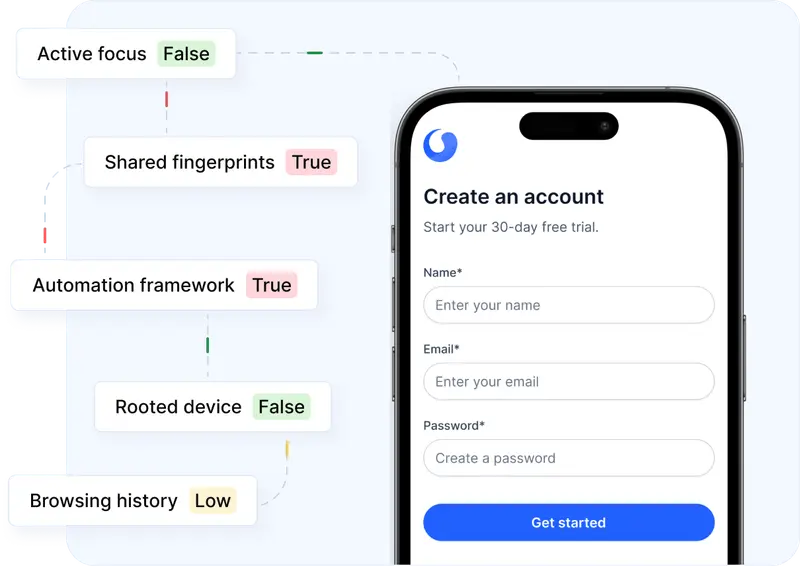
Device fingerprinting is the foundation of identity consistency across sessions. Verisoul doesn't rely on a single fingerprint signal, it generates multiple layers simultaneously:
- Browser fingerprint: canvas, WebGL renderer, audio context, installed fonts, screen geometry, navigator properties, and over 40 additional attributes collected from the browser environment.
- TCP/IP fingerprint: OS-level network stack characteristics that are extremely hard to spoof because they exist below the browser layer and are determined by the underlying operating system.
- Hardware signals: CPU core count, GPU model, memory tier, touch support, and sensor data (on mobile), all cross-referenced against the declared user-agent to flag inconsistencies.
- Anti-detect browser detection: Multilogin, GoLogin, AdsPower, and similar tools inject synthetic property values to fake a convincing fingerprint. Verisoul detects the tell-tale behavioral and structural artifacts these tools leave behind, patterns that are invisible to single-signal fingerprinters but detectable when multiple independent signals are checked against each other.
Critically, Verisoul uses probabilistic matching rather than exact hash matching. This is important because fingerprints change over time, browsers update, screens get replaced, users switch devices. Probabilistic matching means a returning user on a slightly different setup is still recognized as the same person, while two genuinely different people sharing a household IP are not incorrectly flagged as the same account. This distinction alone reduced our false-positive rate significantly compared to hash-based fingerprinters.
2. Account Linking & Multi-Accounting Detection
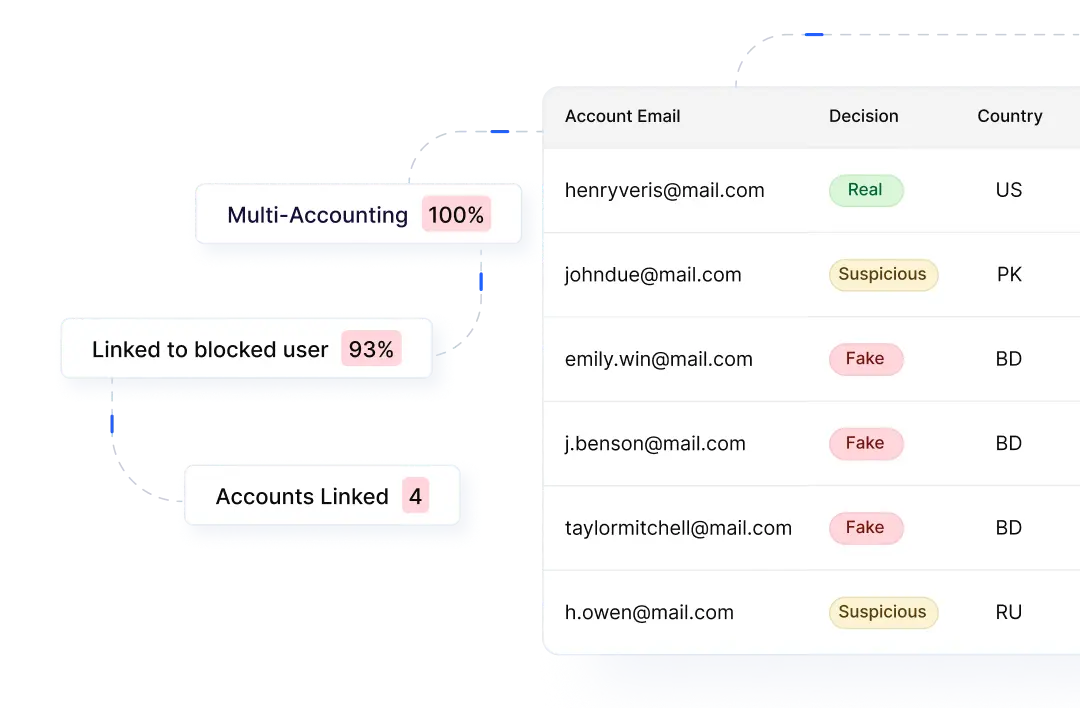
Multi-accounting is the single most costly fraud vector on Shark Earnings. The model is simple: create many accounts, complete the same high-value offers on each, collect multiple payouts. Advertisers pay once per "user" with the expectation of reaching unique people. When that contract is violated, we lose advertiser relationships and every legitimate user suffers through reduced offer availability and tighter payout controls.
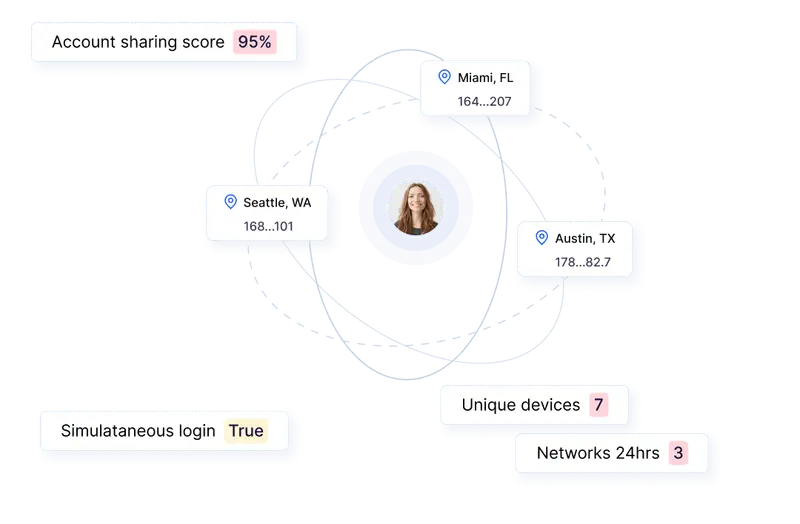
Verisoul builds a real-time account relationship graph. Every new account is placed into this graph based on overlapping signals with existing accounts:
- Shared device fingerprint components (even when deliberately varied)
- Shared network characteristics (IP subnet, ASN, timing patterns)
- Email address patterns (same domain, similar naming convention, same provider fingerprint)
- Phone number relationships (same carrier block, geographic cluster)
- Behavioral timing (accounts that complete tasks in rapid sequence, or that were created within seconds of each other)
- Cross-platform data from Verisoul's network, so if accounts on another platform are linked to each other, that relationship is surfaced to us
Each connection in the graph carries a confidence score. Scores above our threshold trigger automated review; scores above a higher threshold trigger automatic blocking. We review edge cases manually. On Shark Earnings, this has been one of the most impactful features, multi-accounting attempts dropped substantially in the weeks following activation, and the ones that do get through are escalated to our fraud admin dashboard for review.
3. Bot Detection
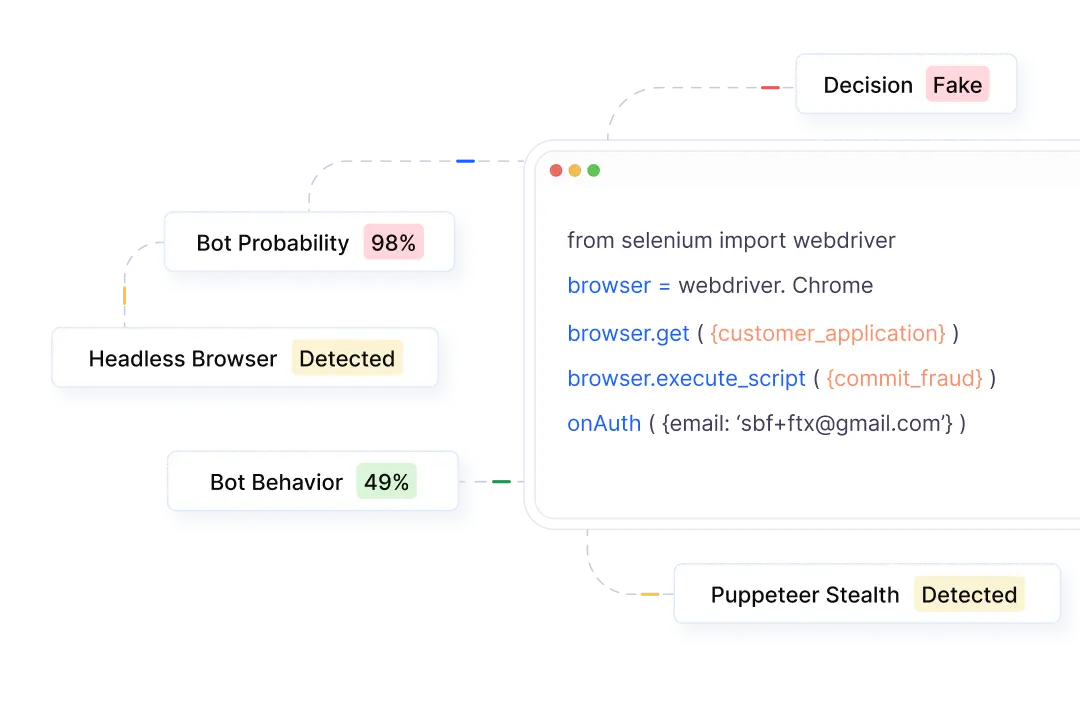
Bots operating on Shark Earnings attempt to complete offers, click through referral chains, or submit surveys at machine speed, creating the appearance of real user engagement while generating fraudulent payouts and depleting advertiser budgets. The problem has grown more sophisticated over time: modern bots use real browser environments (not headless), rotate residential IPs, and introduce deliberate delays to mimic human timing.
Verisoul's bot detection is CAPTCHA-free and fully passive, real users never see a challenge. Detection operates across several dimensions:
- Behavioral biometrics: Mouse movement trajectories, click pressure distribution, scroll patterns, and keystroke timing. Bots produce mathematically perfect inputs; humans don't. Even bots with randomized delays produce statistically distinguishable patterns.
- Environment anomalies: Headless browsers (Puppeteer, Playwright, Selenium), Android emulators, iOS simulators, and virtualized environments leave detectable artifacts regardless of spoofing attempts.
- Automation framework detection: Specific DOM properties, JavaScript runtime globals, and timing characteristics are injected by automation tools and are identifiable at the SDK level.
- Residential proxy rotation patterns: Bot operations cycling through residential proxy pools produce IP-change patterns that are statistically different from genuine user network changes.
This layer specifically protects our offer providers and their advertisers, the same advertisers who fund the rewards you earn. Better bot detection means they trust the traffic we send, which means they continue to run campaigns on Shark Earnings.
4. Email Intelligence
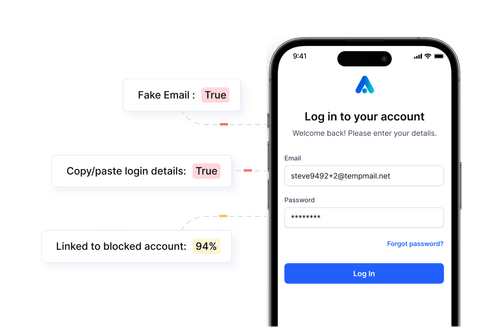
An email address is still the primary credential on most platforms, including ours. The problem is that email addresses are trivially cheap to generate, disposable mailbox services allow unlimited throwaway addresses in seconds, and many fraudsters operate entire account farms behind programmatically generated addresses on catch-all domains they control.
Shark Earnings already maintains its own disposable domain blocklist (the disposable_domains.json file in our system currently contains thousands of known throwaway providers). Verisoul adds a dynamic, behavioral layer on top:
- Disposable and alias detection: Known temporary mail services, plus patterns that suggest accounts like
[email protected]used for inbox farming. - Catch-all domain detection: Domains configured to accept any address regardless of whether a real mailbox exists. Commonly used by fraudsters who control the domain.
- Domain age and reputation: An email on a domain registered three days ago is a vastly different risk profile from one on a domain that's been active for six years.
- Engagement signals: Whether the email address has any history of legitimate account activity across Verisoul's network, a brand-new email that's never been seen anywhere is higher risk than one with years of benign history.
- Synthetic pattern detection: Algorithmically generated email strings (random character sequences, dictionary-word combinations typical of account generators) are flagged even when the domain is legitimate.
5. Proxy & VPN Detection
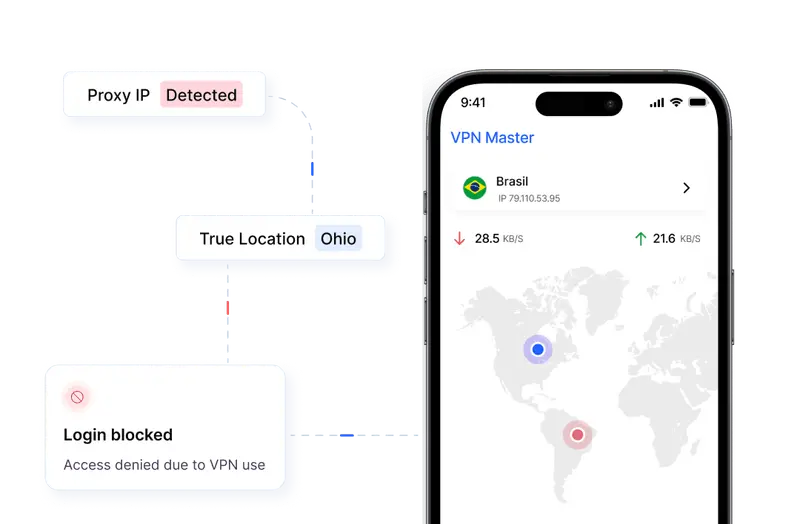
VPN and proxy usage on a reward platform is nearly always adversarial. The most common use case is geographic: locking an offer to the USA doesn't help advertisers if users route through a US exit node from anywhere in the world. The second most common use case is identity obfuscation, cycling IPs to prevent account linking and evade rate limits.
Traditional blocklist-based VPN detection is structurally too slow. A residential proxy pool spun up this week won't appear on a list updated last month. Verisoul takes a fundamentally different approach:
- Active network probing: Rather than only checking the connecting IP against a known-bad list, Verisoul runs over 10 active behavioral tests against the connection in real time, examining how the network stack responds, characteristics that proxies and VPNs distort in detectable ways.
- Residential proxy detection: Residential proxies are specifically designed to look like organic home traffic. Verisoul detects them through timing analysis, ASN behavior patterns, and cross-referencing with its network-wide traffic intelligence.
- Data center vs. residential classification: Data center IPs flagged outright; residential flagged at a lower severity with additional context required before action.
- Tor exit node detection: Tor traffic is blocked across the platform. Tor usage on a reward site has an extremely low legitimate-use rate and a very high fraud-association rate.
- Country legitimacy scoring: Users in countries with high VPN adoption for legitimate reasons (privacy, censorship circumvention) are not penalized purely for being in those countries, behavioral and device signals are weighted alongside the connection type.
We also run ProxyCheck as a supplementary layer specifically for cashout events. Verisoul and ProxyCheck together give us defense in depth, two independent detection methodologies that cross-validate each other before any significant payout is processed.
6. Geolocation & Geographic Consistency
Many of the offers and surveys on Shark Earnings target specific countries or regions, advertisers pay for US users, UK users, or Canadian users specifically, and they pay more for them than for global traffic. Geographic fraud means collecting a US-rate payout while actually being in a lower-rate country and routing through a US proxy.
Verisoul's geolocation layer doesn't just check the IP:
- GPS vs. IP cross-check: On mobile, GPS location (when available) is compared against the claimed IP geolocation. Mismatches above a tolerance threshold are flagged.
- Timezone consistency: The browser-reported timezone must be consistent with the claimed geolocation. A device reporting Pacific Time while connecting from a European IP is flagged.
- Language and locale signals: Browser language settings and system locale are cross-referenced against the declared country.
- Historical location patterns: A returning user who has always connected from Germany and suddenly appears in the US via a datacenter IP is treated differently from a first-time user with consistent US signals throughout.
7. Device Risk Scoring
Every device that accesses Shark Earnings receives a holistic risk score from Verisoul, combining all of the above signals into a single number that our fraud engine acts on. But there are additional device-level signals that feed into this score:
- Rooted and jailbroken devices: Root access on Android and jailbroken iOS remove the security guarantees of the OS, making it easier for fraud scripts to run without app-level detection. These devices receive elevated risk scores on our platform.
- Emulator and simulator detection: Android emulators (Bluestacks, NoxPlayer, LDPlayer) and iOS simulators are overwhelmingly used for bot operations, not legitimate app testing. Detected emulators are blocked outright.
- Cross-platform account density: How many accounts in the Verisoul network are associated with this device? A device linked to 50 accounts across various reward and gaming platforms is a different risk tier than a device with one.
- Verisoul network fraud history: If a device was flagged for fraud on any other platform using Verisoul, that signal is available to us. Fraudsters cannot simply move to a new platform and start fresh.
What the Numbers Look Like on Shark Earnings
We want to be transparent about the scale of fraud that platforms like ours face, because it helps explain why we invest so heavily in detection. Here are some observations from our own data since activating Verisoul:
- A meaningful portion of new account registrations, often in the double digits as a percentage, showing at least one elevated risk signal on their first session. The majority of these are low-severity signals (a shared IP with an existing account, a younger email domain) that don't result in immediate action but are monitored.
- Multi-accounting clusters detected since activation have shown that in the most sophisticated cases, individual operators were running devices in different countries simultaneously, a level of organization that blocklist-based detection would have missed entirely.
- Proxy usage is heavily correlated with referral code abuse, the overwhelming majority of accounts that arrive via referral links and use a proxy are operating a self-referral farm. We block this class of activity automatically.
- Since activating Verisoul's email intelligence alongside our existing disposable domain blocklist, the proportion of registrations using suspicious email patterns dropped significantly, but the attacks shifted rather than stopped, moving toward newly registered domains that aren't yet on static blocklists (which is exactly what Verisoul's dynamic detection handles).
These numbers are why fraud prevention isn't a checkbox we tick, it's actively maintained, monitored, and updated as attack patterns evolve.
One Dashboard, Full Control
All of the above is managed through Verisoul's unified dashboard, supported by our own internal fraud admin panel built on top of the Verisoul data stream. Our admin team can:
- See fraud signal spikes in real time and trace them back to specific campaigns, referral sources, or geographic regions
- Investigate any account in a single click, with full device history, session timeline, account graph connections, and signal breakdown
- Adjust risk thresholds and decision rules without code changes, for example temporarily lowering the proxy-score threshold before a high-value campaign launch
- Manually review edge cases where the confidence score falls in the ambiguous range, with full signal context available to make an informed decision
- Cross-reference Verisoul data with our own platform signals (offer completion patterns, cashout amounts, referral activity) for a full picture
Our previous setup required pulling data from IPQS, FingerprintJS, and our own logs, reconciling them manually in a spreadsheet, and often still not having enough context to make a confident call. Now everything is in one place, with decisions documented and auditable.
What this means for you: Every step on Shark Earnings, from sign-up to cashout, runs through Verisoul alongside our own platform-native checks. If you're a real user, these checks are completely invisible. They run in the background with no friction, no CAPTCHA walls, and no delays. Fraudsters can't dilute the offers and rewards that legitimate users deserve, and advertisers can trust that the traffic they're paying for is genuine, which means they keep running campaigns here, which means more earning opportunities for you.
Our Recommendation
If you run any kind of platform where real users earn rewards, complete tasks, or receive payouts, we genuinely recommend looking at Verisoul. Not as a replacement for good internal fraud operations, you still need humans reviewing edge cases and refining your own ruleset, but as the most accurate and comprehensive fraud intelligence layer we've found in the market.
The biggest differentiator for us wasn't any single feature. It was the combination of:
- Cross-signal correlation: signals that reinforce each other produce far more confident decisions than isolated signals
- Network intelligence: fraud data from across their customer network, continuously updated, available to every platform on it
- Probabilistic matching: catching fraud without over-blocking legitimate users who happen to share an IP or a device
- Zero friction for real users: detection that runs entirely in the background, with no CAPTCHA, no challenges, no false gates
We switched to Verisoul to better protect the platform and every legitimate user on it. Based on what we've seen in our own data, it was the right call, and we're committed to continuing to invest in and maintain strong fraud prevention as Shark Earnings continues to grow.
Learn More
Curious about Verisoul? You can explore their platform at verisoul.ai.

 English
 Magyar
 Deutsch
 Español
 Português
 Français
 Русский